The ramped up rhetoric on Iran is deafening lately. To say the least, claims of Iranian meddling and fomentation in Iraq have reached an unprecedented level. But as vociferous as those claims have been, this time -- as opposed to the runup to the invasion of Iraq -- there seems to be some blowback swirling around up on Capitol Hill. They want evidence this time. Imagine that.
The truth is, the only difference between the runup to the Iraq invasion and the current buildup to a war with Iran is that this time we are the wiser. We have the benefit of hindsight this go around. We're more familiar with the modus operandi of the Bush regime now, and, we know how Dick Cheney & company will resort to bold-faced lies and slick obfuscation in making their case for perpetual war.
This time though, every piece of trumped-up evidence against Iran that Cheney comes up with or every time one of his acolytes hypes the threat, it seems to be falling more and more on a skeptical Congress. In addition, the notion of another war seems to be bombing (no pun intended) in general with the American people as well.
John Conyers’ letter is a direct shot across Cheney’s PNAC-powered bow. Now, whether Conyers’ stark warning is due directly to his aversion to war or it goes straight to a proverbial line in the sand regarding the separation of powers is unclear. But at this point it simply doesn’t matter. America wins either way.
May 8, 2008 The Honorable George W. Bush President of the United States 1600 Pennsylvania Avenue, N.W. Washington, D.C. 20500
Dear Mr. President:
We are writing to register our strong opposition to possible unilateral, preemptive military action against other nations by the Executive Branch without Congressional authorization. As you know, Article I, Section 8 of the U.S. Constitution grants Congress the power "to declare war," to lay and collect taxes to "provide for the common defense" and general welfare of the United States, to "raise and support armies," to "provide and maintain a navy," to "make rules for the regulation for the land and naval forces," to "provide for calling forth the militia to execute the laws of the Union, suppress insurrections and repel invasions," to "provide for organizing, arming, and disciplining, the militia," and to "make all laws necessary and proper for carrying into execution ... all ... powers vested by this Constitution in the Government of the United States." Congress is also given exclusive power over the purse. The Constitution says, "No money shall be drawn from the Treasury but in consequence of appropriations made by law."
By contrast, the sole war powers granted to the Executive Branch through the President can be found in Article II, Section, which states, "The President shall be the Commander-in-Chief of the Army and Navy of the United States, and of the Militia of the several States, when called into actual Service of the United States." Nothing in the history of the "Commander-in-Chief" clause suggests that the authors of the provision intended it to grant the Executive Branch the authority to engage U.S. forces in military action whenever and wherever it sees fit without any prior authorization from Congress.
In our view, the founders of our country intended this power to allow the President to repel sudden attacks and immediate threats, not to unilaterally launch, without congressional approval, preemptive military actions against foreign countries. As former Republican Representative Mickey Edwards recently wrote, "[t]he decision to go to war ... is the single most difficult choice any public official can be called upon to make. That is precisely why the nation’s Founders, aware of the deadly wars of Europe, deliberately withheld from the executive branch the power to engage in war unless such action was expressly approved by the people themselves, through their representatives in Congress."
Members of Congress, including the signatories of this letter, have previously expressed concern about this issue. On April 25, 2006, sixty-two Members of Congress joined in a bipartisan letter that called on you to seek congressional approval before making any preemptive military strikes against Iran. Fifty-seven Members of Congress have co-sponsored H. Con. Res. 33, which expresses the sense of Congress that the President should not initiate military action against Iran without first obtaining authorization from Congress.
Our concerns in this area have been heightened by more recent events. The resignation in mid-March of Admiral William J. "Fox" Fallon from the head of U.S. Central Command, which was reportedly linked to a magazine article that portrayed him as the only person who might stop your Administration from waging preemptive war against Iran, has renewed widespread concerns that your Administration is unilaterally planning for military action against that country. This is despite the fact that the December 2007 National Intelligence Estimate concluded that Iran had halted its nuclear weapons program in the fall of 2003, a stark reversal of previous Administration assessments.
As we and others have continued to review troubling legal memoranda and other materials from your Administration asserting the power of the President to take unilateral action, moreover, our concerns have increased still further. For example, although federal law is clear that proceeding under the Foreign Intelligence Surveillance Act (FISA) "shall be the exclusive means by which electronic surveillance" can be conducted within the U.S. for foreign intelligence purposes, 18 U.S.C. 2511(2)(f), the Justice Department has asserted that the National Security Agency’s warrantless wiretapping in violation of FISA is "supported by the President’s well-recognized inherent constitutional authority as Commander in Chief and sole organ for the Nation in foreign affairs". As one legal expert has explained, your Administration’s "preventive paradigm" has asserted "unchecked unilateral power" by the Executive Branch and violated "universal prohibitions on torture, disappearance, and the like."
Late last year, Senator Joseph Biden stated unequivocally that "the president has no authority to unilaterally attack Iran, and if he does, as Foreign Relations Committee chairman, I will move to impeach" the president.
We agree with Senator Biden, and it is our view that if you do not obtain the constitutionally required congressional authorization before launching preemptive military strikes against Iran or any other nation, impeachment proceedings should be pursued. Because of these concerns, we request the opportunity to meet with you as soon as possible to discuss these matters. As we have recently marked the fifth year since the invasion of Iraq, and the grim milestone of 4,000 U.S. deaths in Iraq, your Administration should not unilaterally involve this country in yet another military conflict that promises high costs to American blood and treasure.
Sincerely, The Honorable John Conyers Chairman of the House Judiciary Committee
Conyers is showing some real guts lately and once again I think we need to let him know that we have his back. He sent a letter to his fellow congress critters asking them to co-sign the letter to Bush. Please contact both the Judiciary Committee and your district representative to urge them to sign onto Conyers' letter.
Conyers is on a roll, folks. Let’s get behind him and give him a push.
Fox commentator: Ron Paul revolt could be 'disaster' for Republicans
David Edwards and Muriel Kane
Rep. Ron Paul is still in the GOP race and even drew 16% of the vote in the recent Pennsylvania Republican primary. Now his supporters are planning to stage a "revolt" at the Republican National Convention in September, possibly with the aim of securing Paul a prime time speaking slot.
Conservative radio talk show host Mike Gallagher told the hosts of Fox and Friends on Tuesday, "There is no question that this could be a major headache for John McCain."
"John McCain would be well-served to kind of reach out and give him an olive branch at the convention," Gallagher continued. "Let him speak, give him a role, because if these people are disrespected -- you know, this, combined with Bob Barr's announcement that Barr now is running as a Libertarian, is going to just take votes away from John McCain and could be a disaster for the Republican Party."
Bob Barr recently cited Paul's success as having helped inspire his own candidacy, pointing to "what Ron Paul has tapped into in terms of reaching an awful lot of young people in particular and illustrating very clearly that in this day and age it is possible to reach a lot of young people through the Internet."
Democratic political consultant and commentator Bob Beckel then joined into the Fox discussion, saying of Paul, "I think he ought to get a prime time speech at the convention. This is the only guy that has a bobble doll made for him that his head doesn't move."
"They're nuts," Beckel said of Paul's supporters, hastening to add, "I don't mean nuts in a bad way. They're nuts about their guy."
"I think they ought to do it, Mike," Beckel concluded, laughing. "I think it would be great for you guys to have Ron Paul at your convention."
"It'll show some diversity at the convention," Gallagher acknowledged.
"That's the kind of diversity you need, brother," Beckel affirmed.
This video is from Fox's Fox & Friends, broadcast May 13, 2008.
It was only a matter of time, really. If you ever doubted that Joe Lieberman would be using what's left of his "Independent Democrat" credentials to legitimize the GOP's bogus "Hamas endorsed Obama" attack, here he is on CNN doing just that...
When Wolf Blitzer pointed out that Obama also labels Hamas a terrorist organization, making his position the same as McCain's, Lieberman said, "that's true," adding that Obama "clearly doesn't support any of the values and goals of Hamas."
Then, with depressing predictability, came the inevitable caveat:
But the fact that the spokesperson for Hamas would say they would welcome the election of Senator Obama really does raise the question, "Why?"
And it suggests the difference between these two candidates.
Lieberman is clearly emerging as a chief attack-dog for McCain on foreign policy, and here he is echoing McCain's talking points with unerring precision: While we all know that Obama doesn't in any way support Hamas or its goals, it's okay to use the group to tar the Illinois Senator anyway, merely because McCain and the Republicans want to.
One wonders whether Harry Reid will keep this sort of stuff in mind when considering committee chairmanships in 2009.
The three-way fight for Newsday has become a head-to-head battle
Rupert Murdoch's News Corporation has withdrawn a bid to buy US newspaper Newsday only days after seemingly being in pole position to acquire it.
News Corp, whose titles include the Wall Street Journal and the New York Post, had offered about $580m (£297m) for the New York state-based organ.
However, stiff competition emerged from broadcaster Cablevision and rival newspaper magnate Mort Zuckerman.
A News Corp spokesman said the bid had become "uneconomical".
About turn
Its withdrawal came as a surprise given that as recently as Wednesday Mr Murdoch had said discussions about a deal were at a "pretty advanced" stage.
Cablevision is reported to have trumped News Corp's bid with an $650m offer and Newsday itself has reported that Cablevision is close to concluding a deal.
Mr Zuckerman, who owns the New York Daily News, is reported to have matched News Corp's $580m offer.
Newsday is published by the Tribune newspaper group, owner of the Chicago Tribune and Los Angeles Times, which was bought by property tycoon Sam Zell last year.
News Corp's focus on the US newspaper market has intensified in the past 18 months, during which it clinched a $5bn deal to buy the Wall Street Journal after a bitter struggle.
Newsday is the eighth-largest US newspaper, with daily circulation of about 380,000 copies.
JERUSALEM (CNN) -- Palestinian militants fired eight rockets into Israel early Saturday from Gaza, the Israeli military said.
Three of the rockets landed in the border city of Sderot, causing damage to three buildings but no injuries, the military said.
A mortar attack from Gaza on Friday killed an Israeli man in his yard in southern Israel and wounded three others, according to Israel Defense Forces.
Israel launched two attacks on Hamas outposts in southern Gaza following the man's death and killed five Hamas militants -- two in Rafah and three in Khan Younis, Palestinian security sources said.
The Israeli man's death was the first by mortar since Israel's 2005 disengagement from Gaza. Other deaths have been caused by rocket fire.
There has been a steady increase in rocket and mortar launchings from Gaza since Hamas took over in June 2007. There have been approximately 2,000 launches from Gaza since the start of 2008, about the same number as were launched in all of 2007
US: Hezbollah must be 'accountable' for Lebanon unrest
The United States blamed Hezbollah as well as its patrons Iran and Syria on Friday for deadly unrest that has pushed Lebanon to the edge of civil war, and warned they must be held "accountable."
"The United States is consulting with other governments in the region and with the UN Security Council about measures that must be taken to hold those responsible for the violence in Beirut accountable," the White House said.
A senior US official declined to list any specific steps, and emphasized that there would not be a "one-size-fits-all" approach to Tehran, Damascus, and the Shiite militant group that Washington brands a terrorist organization.
In Washington, Secretary of State Condoleezza Rice strongly reaffirmed US support for pro-Western Lebanese Prime Minister Fuad Siniora and reached out to key world leaders for ways to buttress his government.
"We will stand by the Lebanese government and peaceful citizens of Lebanon through this crisis and provide the support they need to weather this storm," she said in a statement.
Rice discussed the crisis by telephone with her French and Saudi counterparts, Bernard Kouchner and Prince Saud al-Faisal, as well as UN Secretary General Ban Ki-moon, according to spokesman Sean McCormack.
She was also expected to reach out to Siniora.
As the White House declared itself "very troubled" by the unrest, Rice denounced the violence and singled out Syria and Iran for backing Hezbollah, which she accused of trying "to protect their state within a state."
"We condemn the use of violence by illegitimate armed groups and call upon all parties to respect the rule of law," she said.
"Backed by Syria and Iran, Hezbollah and its allies are killing and injuring fellow citizens, undermining the legitimate authority of the Lebanese government and the institutions of the Lebanese state," said Rice.
State Department officials, who declined to be named, said the United States would provide diplomatic and political support to Siniora, ruling out any military backing for the time being.
Hezbollah fighters Friday seized control of west Beirut after three days of deadly street battles with pro-government foes which have pushed Lebanon dangerously close to all-out civil war.
White House spokesman Gordon Johndroe urged Hezbollah to "stop their attempt to defy the lawful decisions" of the government, which recently opted to probe the group's private communications network -- triggering a violent response.
"We also urge Iran and Syria to stop their support of Hezbollah and its destabilizing effects on Lebanon," he told reporters.
President George W. Bush, on his Texas ranch for the wedding of one of his daughters, still hopes to meet with Siniora in Egypt next week -- but would understand if the prime minister cancelled his visit, said Johndroe.
"We certainly expect to see Prime Minister Siniora in Sharm el-Sheikh next week. The president would like to see him next Saturday or Sunday. But if he feels the situation on the ground doesn't permit him to do that, we understand that as well," said the spokesman.
As Saudi Arabia called for an urgent meeting of Arab foreign ministers to defuse the crisis, Johndroe urged "the countries in the region to support the democratically elected government of Lebanon."
And McCormack charged that there was evidence of Syria-linked individuals and groups "fanning the flames of violence" in Lebanon.
As the fighting eased, Lebanese army and police moved across areas now in the hands of Iranian- and Syrian-backed opposition forces which have been locked in an 18-month power struggle with the ruling coalition.
"After months of paralyzing the democratically elected Lebanese government, Hezbollah has now turned its arms against the Lebanese people and challenged Lebanon's security forces for control of the streets," said Johndroe.
A senior State Department official who asked not to be named suspected Hezbollah's gambit was to stage a "show of force" that would draw compromises from the pro-Western majority.
"We don't know for sure what is going to happen in Lebanon," the official said. "But the idea of a Hezbollah coup d'etat that is sustainable in Lebanon does not strike me as very realistic, just given the demographics."
But as foreigners scrambled to leave it was unclear what the immediate future would hold, amid fears the protracted political feud could plunge Lebanon back into the dark days of the 1975-1990 civil war.
BEIRUT, Lebanon (AP) — Hezbollah gunmen seized control of several Beirut neighborhoods from Sunni foes loyal to the U.S.-backed government on Friday as sectarian clashes reminiscent of Lebanon's bloody 15-year civil war raged in the capital.
At least 11 people have been killed and more than 20 wounded in three days of street battles and gunfights, security officials said.
About 100 Shiite Hezbollah militants wearing camouflage uniforms and carrying assault rifles marched down Hamra Street, a normally vibrant commercial strip in a mainly Sunni area of Beirut. They took up positions in corners and sidewalks and stopped the few cars braving the empty streets to search their trunks.
On nearby streets, dozens of fighters from another Hezbollah-allied party appeared, some wearing masks and carrying rocket-propelled grenade launchers.
In another sign that the Hezbollah-led opposition was gaining steam, the satellite TV station affiliated with the party of Lebanon's top Sunni lawmaker, Saad Hariri, was forced off the air Friday. Gunmen also set the offices of the party's newspaper, Al-Mustaqbal, on fire in the coastal neighborhood of Ramlet el-Bayda.
Lebanon's army, which has stayed out of the sectarian political squabbling that has paralyzed the country for more than a year, only intervened after the building was set ablaze. Troops provided cover for firefighters, who eventually extinguished the flames.
The army also evacuated employees from the TV station, but only after gunmen massed near it and threatened to destroy it, said Nadim Mounla, the station's chief.
Meanwhile, a rocket-propelled grenade hit the fence of Hariri's heavily protected residence, security officials said, speaking on condition of anonymity because they were not allowed to speak to the media.
Hariri and his ally, Druse lawmaker Walid Jumblatt, were besieged in their homes, and Prime Minister Fuad Saniora and several ministers were holed up in Saniora's downtown office surrounded by troops and police.
The escalating fighting could have implications for the entire Middle East at a time when Sunni-Shiite tensions are high. The tensions are fueled in part by the rivalry between predominantly Shiite Iran, which sponsors Hezbollah, and Sunni Arab countries like Saudi Arabia and Egypt.
The crackle of gunfire and occasional explosions continued to reverberate across the western, largely Muslim, sector of Beirut Friday.
On Hamra Street and in other neighborhoods once dominated by government supporters, Shiite gunmen roamed unopposed. Dozens of cars and shops had been damaged by the fighting.
"We entered Karakol Druse. There is no Jumblatt and no Hariri here," a Shiite gunman told Associated Press Television News.
"We entered the neighborhood. They threw away their weapons and ran," said another gunman as one of his colleagues tore down a poster of Hariri.
The scenes were a grim reminder of Lebanon's devastating 1975-90 civil war in which 150,000 were killed and parts of the city wrecked as it was carved into warring sectarian enclaves.
Street clashes exploded into gunbattles in parts of Beirut on Thursday afternoon after Hezbollah leader Hassan Nasrallah accused Lebanon's Western-backed government of declaring war on his Shiite militant group. It was the militant leader's strongest comments since Lebanon's political crisis erupted 17 months ago.
Hariri later went on television urging Hezbollah to pull its fighters back and "save Lebanon from hell." He proposed a compromise that would involve the army, one of the sole national institutions respected by Lebanon's long deadlocked factions.
But Hezbollah and its allies swiftly rejected the offer.
Officials with Lebanon's pro-government majority called an emergency of lawmakers in a mountain town in the country's Christian heartland, LBC-TV, a pro-government Christian station reported Friday. But it was unclear who would be able to attend since several lawmakers were holed up in their homes or offices.
"Even if Hezbollah's militia took everything we remain the constitutional authority," Cabinet Minister Ahmed Fatfat told Al-Arabiya TV from Saniora's compound.
The unrest has virtually shut down Lebanon's international airport and barricades closed major highways.
Hezbollah first blocked roads in Beirut on Wednesday to enforce a strike called by labor unions, but confrontations quickly spread and became more violent. Factions threw up roadblocks and checkpoints dividing Beirut into sectarian enclaves, and the chattering of automatic weapons and thumps of rocket-propelled grenades echoed across the city overnight.
The clashes are the latest turn in a test of wills between the Hezbollah-led opposition and the Saniora government.
The government, which is allied with the U.S. and Saudi Arabia, has only a slim majority in parliament. The two sides have been locked in a power struggle that has kept government at a standstill and the country without a president since November.
Following New York City health department reports of increasing HIV diagnoses in young gay men of color, Mayor Michael R. Bloomberg's proposed 2009 budget cuts at least $1.3 million in the health department's AIDS services and HIV testing efforts.
"As a result of the six percent reduction required of all agencies in the mayor's executive budget plan, the health department will be reducing some expenditures across the agency," the department wrote in a May 7 statement responding to a May 2 query from Gay City News. "The reductions include a $1.3 million cut in HIV/AIDS service contracts and our rapid test kit distribution to local hospitals."
All of the HIV and sexually transmitted disease programs are part of the department's disease control and epidemiology budget, which was cut by $2.6 million from more than $102 million in 2008 to $99.5 million in 2009, so cuts to HIV services account for half of all cuts in that budget.
Overall, the health department budget was reduced by $116 million from more than $1.6 billion to $1.5 billion, according to city budget documents. The mayor announced the $59.1 billion city budget, in which spending grew by 0.1 percent, on May 1.
According to Gay City News' review of the budget documents, net cuts totaling $4.4 million came from the health department's HIV and sexually transmitted disease programs and 46 jobs in those programs are eliminated. The budget also cut three jobs and $200,000 for efforts at monitoring methicilin-resistant staph infections, or MRSA.
The health department reported a 60 percent increase in syphilis cases in 2007 over 2006 among gay and bisexual men. MRSA has emerged as a serious health problem among gay men in New York City and across the country.
"Much of the apparent HIV and STD drop in funding for personnel is misleading, since many federal grants received by the health department in fiscal year 2008 have not yet been added to the agency's budget for fiscal year 2009," the department wrote. "These funds are never reflected in the executive budget. This includes approximately 25 staff positions, the vast majority of which we anticipate being included when these grants are eventually recognized in our 2009 budget."
Discretionary funding from the City Council was not included in the proposed budget and may pay for some of those positions so they only appear to be vacant. Others may be long-term vacancies.
As Gay City News went to press, a health department spokesperson was unable to provide additional detail. AIDS groups either did not respond to requests for comment or were still making their own reviews of the 2009 city budget and could not comment.
Apparently, even the mayor can be confused by the budget.
At a May 6 Times Square press conference, Gay City News asked the Bloomberg, "Your proposed budget for 2009 cuts syphilis, sexually transmitted disease, and AIDS services at the health department. Can you explain those cuts?"
The mayor responded, "Your facts are wrong. It does not cut at all. Those are very high priority things at our health department. Early detection can make a very big difference in treatment and, while we have to focus on education so that people know how to prevent catching sexually transmitted diseases, we have to make sure that everybody knows their status... We didn't cut anything. We tried to move things around within the agency to make it function better."
The question and the mayor's answer were taped. On May 7, Stu Loeser, the mayor's press secretary, called Gay City News to say that the mayor thought the newspaper was asking about the health department closing the Office of Lesbian, Gay, Bisexual and Transgender Health. Gay City News reported that in February.
"I think there was a misunderstanding," Loeser said. "Our understanding was that you were asking about the LGBT health office."
The press conference was on an island in the middle of Times Square as traffic continued to move by on both sides and the sound system that reporters used to ask questions was malfunctioning.
The cuts, whatever their size, come as 15 gay and AIDS groups, dubbed the Emergency Response Coalition for MSM of Color, are asking the City Council to add $5.5 million to the budget to address HIV among African-American, Latino, Asian-American, and Native-American men who have sex with men.
Gay and AIDS groups have also been complaining that funds previously allocated by the City Council to address AIDS in communities of color are not being released quickly enough.
At a May 1 hearing of the Council's Health Committee, Maria del Carmen Arroyo and Helen D. Foster, who represent parts of the Bronx, Rosie Mendez, who represents Manhattan's Lower East Side, and Letitia James from Brooklyn pressed two senior health department staffers on the department's response to increasing HIV infections among young men of color.
"We need to hear from the department when do you anticipate having this strategy?" Arroyo asked Dr. M. Monica Sweeney, assistant commissioner for the Bureau of HIV/AIDS Prevention and Control.
The department expects to roll out prevention campaigns within the next six months, Sweeney said.
James was particularly pointed in her comments, suggesting that the mayor and the City Council may not be responding because African-American gay men are affected.
"It goes to the racism and homophobia that is in this building... and in this Council I might add," she said.
When Keith Olbermann offered an overview on Wednesday of recent Bush administration scandals, he touched on the failure to protect whistleblowers and the refusal to reappoint the one member of the Federal Election Commission who spoke out against John McCain’s attempt to opt out of federal campaign financing after using that financing as a loan guarantee.
But Olbermann’s harshest comments were directed against Max Boot, a senior fellow at the Council on Foreign Relations, whom Olbermann described as “one of the administration’s consulting dumbasses, who got us into the quagmire in Iraq and is now pushing hard for a twin disaster in Iran.”
Boot insisted in an online debate Tuesday that the surge has worked because “civilian deaths were down more than 80%, US deaths more than 60%, between September 2006 and March 2008.”
However, Boot also argued in the Wall Street Journal on Monday that the jump in American fatalities in April “could be a sign that tough combat is under way that will lead to the enemy’s defeat and the creation of a more peaceful environment in the future.”
“And there it is, in all its beautiful, elliptical, symmetrical, asinine Bushian glory,” Olbermann concluded.
“If fewer Americans die in Iraq, that’s because the surge is working. If more Americans die in Iraq, that’s also because the surge is working. And if the surge is working, the troops have to stay longer to solidify its gains. And if the surge isn’t working, the troops have to stay longer to make sure it starts working.”
“And the point of the war in Iraq is to make sure there is a war in Iraq.”
This video is from MSNBC’s Countdown, broadcast May 7, 2008.
Thu May 8, 6:45 AM ET TEHRAN - Iran's hardline President Mahmoud Ahmadinejad on Thursday called Israel a "stinking corpse" which is doomed to disappear as the Jewish state celebrated its 60th anniversary.
"Those who think they can revive the stinking corpse of the usurping and fake Israeli regime by throwing a birthday party are seriously mistaken," Ahmadinejad was quoted as saying by the official IRNA news agency. "Today the reason for the Zionist regime's existence is questioned, and this regime is on its way to annihilation," he said.
Ahmadinejad added that Israel "has reached the end like a dead rat after being slapped by the Lebanese" -- a reference to the July-August 2006 war between Israel and the Shiite Hezbollah militia.
Iran does not recognise the Jewish state, and since becoming president in 2005 Ahmadinejad has repeatedly provoked international outrage by predicting that Israel is doomed to disappear.
He has also caused controversy by playing down the scale of the Holocaust.
As Democrats coalesce around Sen. Barack Obama, one of Hillary Clinton's must outspoken supporters is not mincing words: the party is walking needlessly and unaware into a general election buzzsaw.
"I believe Obama probably will win [the Democratic nomination], although in politics you never ever can count anybody out," said former New York Mayor Ed Koch. "I think Hillary is doing a magnificent job and is a great candidate and if anybody can pull it out, she can. But my honest opinion is, it probably won't happen. And that he will be the candidate and that he will lose."
Koch's argument, while never voiced in public by Clinton, is thought to reflect the opinion of the senator and her key aides.
In an interview with The Huffington Post, Koch warned that despite Obama's lead in every single primary election metric, the Illinois Democrat simply would not be able to best John McCain come November. As such, he urged Clinton to stay in the race even as some in the party call for her drop out now, even before Obama has officially secured the nomination.
Were the majority of states and voters who had gone to Obama - and the superdelegates who could very well affirm their decisions - making a grievous political mistake?
"Mistake is not exactly the word," replied Koch. "It is the wrong judgment. The reason that the superdelegates are there is to select that person who is most likely to prevail. And...even though he does not win on his own merits in terms of racking up sufficient delegates, in all probability the superdelegates will be afraid to exercise their own judgment. And we will simply go along with the count of the delegates that were chosen in the polls."
Koch's argued that Obama showed a complete lack of conviction and leadership in handling the controversy surrounding his former pastor. The theme is a constant feature in the former mayor's syndicated columns, several of which have directly questioned the credibility of Obama's attempts to distance himself from Reverend Jeremiah Wright.
"I am shocked, without knowing the reason that it is happening, that none of the allegations with the respect of Wright, his former pastor, have had any impact on his polling," said Koch. "I'm absolutely surprised because I think that all the things that Wright says -- and nobody believes that Obama supports those statements -- but he didn't have the courage to stand up and object for twenty years. If you are running for president, you can't be like some other poor guy in the pews who is afraid to stand up or even say something privately to the minister. You're the guy who wants to lead the country and you have to have courage to stand up and lead your own pastor. He did not exhibit that. But the fact that the Democratic constituency doesn't seem to care is a shock to me, but I'm certain that the overall constituency voting in November will care and that it will make the difference in the adverse way to his candidacy."
On Tuesday night, Obama won a decisive victory in North Carolina and closely lost his contest against Clinton in Indiana. The strong showing followed a week in which Wright not only reemerged on the political landscape but also suffocated the subsequent news coverage. Koch called Obama's ability to overcome the pastor problem and score well in the two primaries a "serious victory" but one that did not end the game.
Saying he would support Clinton and "hope she ultimately prevails," Koch wasn't worried that Democratic infighting could hurt the party's chances in the fall. It was Obama's candidacy, he repeated, that would be the death knell.
"I believe that when the voting is over that the vast majority, not all, on both sides, will vote for the [Democratic] candidate," said Koch. "But that applies only to the Democrats who have been participating. I believe that the vast majority of voters will look at all of these allegations, which nobody disputes, as related to Wright and his comments, and that they will have an enormous impact on the vote and on those Independents and others who will make a decision in the general election. I just think he is a loser because of that."
Sean Malloy, a professor at the University of California Merced, "recently unearthed 10 previously-unpublished photographs illustrating the aftermath on the Hiroshima bombing."
These photographs, taken by an unknown Japanese photographer, were found in 1945 among rolls of undeveloped film in a cave outside Hiroshima by U.S. serviceman Robert L. Capp, who was attached to the occupation forces. Unlike most photos of the Hiroshima bombing, these dramatically convey the human as well as material destruction unleashed by the atomic bomb.
Below, you'll find one of the photos from this collection. See the rest here. Warning: some of the images are graphic and will be difficult for some readers to view. (Via Danger Room)
Photos of Hiroshima from the Robert L. Capp Collection
The Robert L. Capp collection at the Hoover Institution Archives contains ten never-before-published photographs illustrating the immediate aftermath of the Hiroshima bombing. These photographs, taken by an unknown Japanese photographer, were found in 1945 among rolls of undeveloped film in a cave outside Hiroshima by U.S. serviceman Robert L. Capp, who was attached to the occupation forces. Unlike most photos of the Hiroshima bombing, these dramatically convey the human as well as material destruction unleashed by the atomic bomb. Mr. Capp donated them to the Hoover Archives in 1998 with the provision that they not be reproduced until 2008. Three of these photographs are reproduced in Atomic Tragedy with the permission of the Capp family. Now that the restriction is no longer in force, the entire set is available below. Please contact Sean L. Malloy (smalloy@ucmerced.edu) if you have any information that might help identify the original photographer.
Doctors say there has been a rapid rise in infant health conditions
Doctors in Afghanistan say rates of some health problems affecting children have doubled in the last two years.
Some scientists say the rise is linked to use of weapons containing depleted uranium (DU) by the US-led coalition that invaded the country in 2001.
A Canadian research group found very high levels of uranium in Afghans during tests just after the invasion.
A US forces spokesman denied its weapons were affecting the health of Afghans or the country's environment.
But claims made in the BBC World Service One Planet programme suggest the invasion may have left an unwelcome legacy for the country's environment and the health of its people.
We don't use depleted uranium in Afghanistan; we don't have a requirement to use that
Major Chris Belcher Coalition spokesman
Doctors in Kabul and Kandahar showed data indicating that the incidence of a number of health conditions, including birth defects, has doubled in under two years.
"We have premature births and malformations," said one doctor, who wished to remain anonymous, in one of the main maternity and neo-natal hospitals in the country.
"Malformations include neural tube defects and malformation of limbs; for example, the head is smaller than normal, or the head is larger than normal, or there is a big mass on the back of the baby.
"We don't know what is the cause of these malformations."
Heavy metal
The Canada-based Uranium Medical Research Centre (UMRC) believes the cause might be depleted uranium.
In 2002 and 2003 the group ran programmes analysing urine from Afghans.
In some, it found levels of uranium hundreds of times greater than in Gulf War veterans.
Villagers near Tora Bora spoke of their concerns over US weaponry
Asaf Durakovic, URMC's president and a former US army adviser, believes that exposure to DU weapons may have brought a rise in birth defects as well as "symptoms of muscular-skeletal pains, immune system disorders, lung disease, and eventually cancer".
Depleted uranium and natural uranium contain different ratios of two isotopes of the metal.
So scientists can tell whether a person has been exposed to the natural form, or to DU.
DU is used in armour-piercing shells because its density means it can penetrate further than other metals.
Dr Durakovic said his research showed that in Afghanistan, coalition forces had also used DU in "bunker buster" bombs, which can penetrate tens of metres into the soil.
"In Afghanistan it has to be... a weapon that destroys not only bunkers or caves, but also penetrates through the soil and through the fragile environment of the mountains."
Strange fruit
Villagers near the Tora Bora mountains, scene of a massive coalition attack in 2001 aimed at forcing Osama bin Laden out of a cave complex where he was believed to be hiding, suspect the bombs brought an increase in diseases and other problems.
There was a strange smell, and most of the trees here did not yield fruit," recounted Yusuf Khan.
Another villager, Bakhtawar, said: "There were three or four babies born in our area whose arms and legs and faces were not normal; they were malformed."
But Faizullah Kakar, Afghanistan's deputy health minister, countered: "Health defects are common in Afghanistan.
"We want to find out if it is nutritional deficiency or environmental contamination with certain radiation that is doing it."
Disputed claims
The US military rejects claims that it used DU-containing bunker busters in Afghanistan.
It also denies allegations that the weapons it used in Afghanistan are affecting health and the environment.
"We don't use depleted uranium in Afghanistan; we don't have a requirement to use that," said Major Chris Belcher, spokesman for the coalition forces.
The coalition acknowledges DU may have been used here in the past
But he said such weapons might have been used in the past.
"I don't have any knowledge of what might have been used in 2001 and 2002. If there was an armour threat, the DU rounds would have been used to counter that threat."
Dr C Ross Anthony from the Rand Corporation, the US think-tank, suggested use of DU ordnance would have been light in Afghanistan.
"With very few of them (DU weapons) being used, it is hard for me to imagine that much of a real environmental problem exists," he said.
What next?
Some scientific experts suggested performing further research into the alleged damage caused by weapons used in the country.
But officials in Afghanistan's newly established National Environmental Protection Agency said they did not have the necessary equipment or expertise to investigate properly.
And Chris Alexander from the United Nations Assistance Mission for Afghanistan (UNAMA) acknowledged it was a concern, but said: "We have no idea what the scale is, nor do we have special knowledge about environmental implications."
Asaf Durakovic would prefer that concrete measures be taken now.
"The best thing is to relocate the population; people have to be moved from the areas that have been highly contaminated to safe areas to provide medical testing and medical care."
Following the use of DU weapons in Iraq and the Balkans, the World Health Organization (WHO) researched the impact on health and the environment.
It concluded, as did a 2001 European Union enquiry into the Balkans conflict, that DU posed little threat.
A senior WHO official told One Planet it had not received any request from Afghan authorities to investigate the current situation.
Vet's daughter said his suicide was a statement about VA benefits 89-year-old killed self outside clinic By Paul Alongi STAFF WRITER
Harriett Chapman's eyes filled with tears Sunday as she recalled one of the last conversations she had with her 89-year-old father before he fatally shot himself outside a Greenville veterans' clinic last month.
Grover Cleveland Chapman told his family, "No matter what I apply for at the VA, they turn me down," she recalled.
The next day, the World War II veteran took his own life outside the Veterans Outpatient Clinic at 3510 Augusta Road, said Greenville County Deputy Coroner Mike Ellis.
Harriett Chapman sees her father's April 24 death as his way of sending a message about the medical care offered by the U.S. Department of Veterans Affairs.
While staff at the clinic treated him well, he'd recently lost two battles in a continuous struggle to claim medical benefits, she said.
"He felt like the VA turned its back on him and a lot of other veterans," Harriett Chapman said.
Priscilla Creamer, a spokeswoman for the clinic, said a caseworker who met with Grover Cleveland Chapman two days before his death saw nothing that raised a red flag.
"We feel very badly for the family," Creamer said. "We'd be happy to talk with them further if there's anything we can do."
Harriett Chapman, the fifth of seven children, said her father was honorably discharged from the Army and Navy before returning to Greenville, where he worked as a machinist.
He learned in a phone call on the Wednesday before his death that he was going to have to travel to Columbia for medical tests, although he'd been hoping for a waiver that would've allowed him to get them done closer to home, Harriett Chapman said
More bad news came hours later when he received a letter saying he'd been denied "100 percent disability," she said. If he'd been approved, the Veterans Administration would have picked up more of his medical bills, she said.
Grover Cleveland Chapman had the letter with him when he shot himself, Harriett Chapman said.
Creamer referred questions about benefits to the Veterans Benefits Administration regional office in Columbia, where no one could be reached Sunday.
Fiscal Pressures Lead Some States to Free Inmates Early
By Keith B. Richburg and Ashley Surdin Washington Post Staff Writers Monday, May 5, 2008; A01
NEW YORK -- Reversing decades of tough-on-crime policies, including mandatory minimum prison sentences for some drug offenders, many cash-strapped states are embracing a view once dismissed as dangerously naive: It costs far less to let some felons go free than to keep them locked up.
It is a theory that has long been pushed by criminal justice advocates and liberal politicians -- that some felons, particularly those convicted of minor drug offenses, would be better served by treatment, parole or early release for good behavior. But the states' conversion to that view has less to do with a change of heart on crime than with stark fiscal realities. At a time of shrinking resources, prisons are eating up an increasing share of many state budgets.
"It's the fiscal stuff that's driving it," said Marc Mauer, executive director of the Sentencing Project, a Washington-based group that advocates for more lenient sentencing. "Do you want to build prisons or do you want to build colleges? If you're a governor, it's kind of come to that choice right now."
Mauer and other observers point to a number of recent actions, some from states facing huge budget shortfalls, some not, but still worried about exploding costs.
· To ease the overcrowding and save California about $1.1 billion over two years, Gov. Arnold Schwarzenegger (R) has proposed freeing about 22,000 prisoners convicted of nonviolent, nonsexual offenses 20 months earlier than their scheduled release dates. He also wants to place them on unsupervised parole, saving the state the cost of having all parolees assigned to an agent.
· Lawmakers in Providence, R.I., approved an expansion last week of the state's "good time" early-release rules to cover more inmates serving shorter sentences. The new rules, which will put more inmates under post-prison supervision, are expected to save Rhode Island an estimated $8 billion over five years.
· In Kentucky, where 22,000 state inmates are housed in county prisons and private facilities, lawmakers agreed to allow certain nonviolent, nonsexual offenders to serve up to 180 days of their sentences at home, and to make it easier for prisoners to earn credit for good behavior. The move could save the state, which is facing a $900 million deficit over the next two years, as much as $30 million.
· In Mississippi, where the prison population has doubled during the past dozen years to 22,600, Gov. Haley Barbour (R) has signed into law two measures that will reduce it: One to let certain nonviolent offenders go free after serving 25 percent of their sentences, and the other to release some terminally ill inmates.
· South Carolina, meanwhile, is looking to abolish parole, in part to slow the growth of its prison population since there would be fewer people returned to prison for parole violations.
Proposals to free prisoners are still met with opposition, particularly from law enforcement officials who fear that a flood of released felons could return to their communities, and from victims groups that worry that justice is being sacrificed for budgetary concerns.
The California plan has drawn criticism from the Legislative Analyst's Office, the state's nonpartisan fiscal adviser, which warned that 63,000 mid-level offenders would "effectively go unpunished, serving little or no prison time" and would not have active supervision.
The proposal also worries local governments and police in California, particularly in Los Angeles County -- home to the nation's largest prison system, which supplies about a third of the state's prison population. "It's kind of like the volcano has erupted," County Sheriff Lee Baca said. "To let out 63,000 prisoners on summary parole -- which means no parole -- is not good policy."
Bob Pack, 52, of Danville, Calif., is particularly disturbed by the prospect of softer punishment forthose convicted of drunken driving. In 2003, Pack's two children -- Troy, 10, and Alana, 7 -- were struck and killed when a drunk driver's car jumped a curb and ran onto a neighborhood sidewalk. The driver had three prior drunken-driving convictions.
Said Pack: "I guarantee you that if this program is fulfilled, somewhere down the road -- it could be three months or a year -- there's going to be a family in court over the death of a loved one, because of someone who got out early."
But for now, state officials are finding themselves under mounting pressure to cut costs and are looking at their rising prison population.
Between 1987 and last year, states increased their higher education spending by 21 percent, in inflation-adjusted dollars, according to the Pew Center on the States. During the same period, spending on corrections jumped by 127 percent.
In the Northeastern states, according to the Pew report, prison spending over the past 20 years has risen 61 percent, while higher education spending has declined by 5.5 percent.
California -- which has the country's worst fiscal crisis, with a potential shortfall of $20 billion -- has seen its prison-related spending swell to $10.4 billion for the 2008-2009 fiscal year. About 170,000 inmates are packed into California's 33 prisons, which were designed to hold 100,000. About 15,000 prisoners are being housed in emergency beds, in converted classrooms and gymnasiums.
Rhode Island's prison population peaked and its 4,000-inmate prison capacity was exceeded in recent years, prompting a lawsuit and a court settlement. "The soaring inmate census has created a crisis here," said Ashbel T. Wall, the state's corrections director. "We've been busting the budget continuously. . . . Our prisons have been packed."
New Jersey is one state making changes out of a desire for more efficiency. Gov. Jon S. Corzine (D) is proposing legislation to expand drug courts to channel more nonviolent, first-time drug offenders into treatment instead of prisons, and also to expand supervised parole. Another proposal would change the parole policy so parolees were not automatically returned to prison for minor drug offenses, said Lilo Stainton, the governor's spokeswoman.
She said that in New Jersey's case, the changes are not budget-driven. "We think this is a more humane and sensible way to treat people," she said.
Michigan is grappling with a massive prison population, mainly because "truth in sentencing" rules make the state less generous about granting paroles. Michigan's incarceration rate is 47 percent higher than that of the other Great Lakes states, according to experts.
Michigan has become one of the few states that actually spend more on prisons than on higher education -- about $2 billion for prisons, and $1.9 billion in state aid to its 15 public universities and 28 community colleges. "It's insane," said Barbara Levine of the Citizens Alliance on Prisons and Public Spending in Lansing. "The governor is always talking about how we need to be high tech. But these days, the best career opportunity is to get a job as a prison guard."
In fact, according to Thomas Clay, a prisons and budget expert with Michigan's nonprofit Citizens Research Council, the state government employed 70,000 people in 1980, including 5,000 working for the prisons system. Today, the number of state workers has dropped to 54,000, but 17,000 work for the prisons.
"You've got two decades of failed policies," said Laura Sager a consultant in Michigan for Families Against Mandatory Minimums. She said mandatory sentencing laws and tough penalties for drug offenses in the 1980s "bloated prisons and prison populations, and the taxpayer is paying a very high price."
Now with states struggling with budget deficits, she said, "you have pressures that make it palatable to take a second look."
May 1 was the fifth anniversary of George Bush’s “Mission Accomplished” speech, in which he claimed, “Major combat operations in Iraq have ended. In the battle of Iraq, the United States and our allies have prevailed.”
MSNBC’s Keith Olbermann began his commemoration of this anniversary by saying there had been nothing comparable to Bush’s “misleading, disingenuous, deliberately deceptive” speech since Neville Chamberlain’s declaration of “peace for our time” after capitulating to Hitler in 1938.
Olbermann noted that even now the administration keeps insisting that the only problem with the speech was that the huge “Mission Accomplished” banner behind Bush on the aircraft carrier was misinterpreted as referring to the Iraq War rather than to the mission of that particular ship. “We have certainly paid a price for not being more specific,” stated White House Press Secretary Dana Perino on Tuesday.
Rachel Maddow of Air American pointed out that the White House seems to think that if not for the banner, “nobody would have minded that Bush declared major combat over, that he wore the flight suit, that he kept that aircraft carrier off the coast of San Diego for the purpose of the photo op, and that we had ‘prevailed.’ … As if it just needed to be rebranded.”
“What is it going to take to reignite that core of anger … over this god-forsaken war?” Olbermann asked.
“The well of anger about Iraq is always there to be tapped,” Maddow answered. “But I think that it maybe becomes something that can’t be shushed … when we start focusing on the opportunity costs of what we’ve done.”
“We want to know that we are getting something that we need as a country from what we have devoted to these wars,” Maddow explained. “We want to know that the investment we’ve made in blood and honor and in our international standing … [has] brought us something that we need as a country.”
“If it hasn’t decreased our risk of terror, it hasn’t weakened our adversaries, all it’s done is weaken our own military and our own international standing, what’s it been for?” concluded Maddow.
“We can pretty much assume we know the answers to that,” commented Olbermann. “There are many of them, they’re all nefarious and conspiratorial.”
This video is from MSNBC’s Countdown, broadcast May 1, 2008.
Late in the game and against all odds, Senator Hillary Clinton appears to be generating a significant rally.
"A bevy of new national polls, plus surveys in Indiana and North Carolina -- which hold key primaries on Tuesday -- suggest that Hillary Clinton is closing the gap since her campaign-saving victory in Pennsylvania last week, and that the controversies dogging Barack Obama are having an impact," Foon Rhee reports for The Boston Globe.
The article continues, "In a national Fox News/Opinion Dynamics poll, Clinton leads Obama 44 percent to 41 percent. The Illinois senator is viewed unfavorably by 42 percent of all voters, up 9 percentage points since February. Clinton's unfavorable rating is still slightly higher than Obama's, but it has dropped slightly. And by 10 percentage points, Democrats now view Clinton as likelier than Obama to beat presumptive Republican nominee John McCain. Democrats gave Obama a 4-point edge last month."
Rhee cites other polls, including a NBC/Wall Street Journal survey, a national New York Times/CBS poll, and a Quinnipiac University poll, which indicate that Obama has taken a hit from the controversy over his former pastor's remarks. But ones taken over the next week might be even more of a barometer, since some of these polls were taken before Obama's latest speech which attempted to distance him further from Wright.
For now, Clinton is beginning to surge in a state that Obama has led for some time now: North Carolina, whose May 6 Democratic primary is set for May 6. Clinton has gained some ground in one poll, while another survey shows the former first lady with a slight lead.
Obama leads with 49 percent over Clinton's 42 percent in the Mason-Dixon Polling & Research Inc. poll, which was conducted April 28-29 for WRAL-TV in Raleigh and WBTV in Charlotte. It included interviews with 400 likely Democratic primary voters, for whom the margin of sampling error was plus or minus 5 percentage points.
Obama leads Clinton 63-26 among voters under age 35, while Clinton has a 47-45 edge among voters over 50. He has the support of 87 percent of black voters, while Clinton leads among whites with 62 percent. By party registration, Obama led 48 percent to 43 percent among Democrats and 55-38 among independent or unaffiliated voters. Fifty-five percent said they were looking most for a candidate who "represents change and a new approach," while 36 percent said they wanted someone who "has the right experience." The poll was conducted as news broke that Gov. Mike Easley would endorse Clinton.
Meanwhile, according to a InsiderAdvantage/Majority Opinion Survey of 571 registered likely voters in North Carolina, Clinton has "moved from a double digit deficit in an InsiderAdvantage poll taken in mid-April to a two point lead over Sen. Barack Obama in this telephone survey, conducted April 29. The survey was weighted for age, race, gender, and political affiliation. It has a margin of error of plus or minus 3.8%. The results were: Hillary Clinton: 44%, Barack Obama: 42%, Undecided: 14%."
However, InsiderAdvantage’s Matt Towery doesn't think that Clinton is a lock in North Carolina at all.
"The shift has come almost entirely from white voters age 45 and over. There was a small drift of African-Americans back towards Clinton, but not so significant as to establish any trend," Towery recently said on Fox. "I believe when all is said and done, Obama will likely carry North Carolina; or if he loses the race, it will be by just a few points."
Towery added, "Our polling generally does not indicate the eventual compression of black voters that Obama usually enjoys just before Election Day. If that happens, my guess is that he will pull this out. However, this poll is clearly an indication of reaction to the latest statements by his former pastor; and it forces Sen. Obama to split resources between Indiana and North Carolina."
"If this white vote shift does not erode, given that North Carolina’s white Democratic voters are primarily in the Research Triangle, where education and personal finances are in the top tier for the nation, then I would say this suggests a major shift in all future primaries towards Clinton," said Towery
Larisa Alexandrovna, Muriel Kane and Lindsay Beyerstein
The Permanent Republican Majority Part VI
MONTGOMERY, ALABAMA – In two states where US attorneys are already under fire for serious allegations of political prosecutions, seven people associated with three federal cases have experienced 10 suspicious incidents including break-ins and arson.
These crimes raise serious questions about possible use of deliberate intimidation tactics not only because of who the victims are and the already wide criticism of the prosecutions to begin with, but also because of the suspicious nature of each incident individually as well as the pattern collectively. Typically burglars do not break-into an office or private residence only to rummage through documents, for example, as is the case with most of the burglaries in these two federal cases.
In Alabama, for instance, the home of former Democratic Governor Don Siegelman was burglarized twice during the period of his first indictment. Nothing of value was taken, however, and according to the Siegelman family, the only items of interest to the burglars were the files in Siegelman's home office.
Siegelman's attorney experienced the same type of break-in at her office.
In neighboring Mississippi, a case brought against a trial lawyer and three judges raises even more disturbing questions. Of the four individuals in the same case, three of the US Attorney’s targets were the victims of crimes during their indictment or trial. This case, like that of Governor Siegelman, has been widely criticized as a politically motivated prosecution by a Bush US Attorney.
The main target of the indictment, attorney Paul Minor, had his office broken into, while Mississippi Supreme Court Justice, Oliver E. Diaz Jr., had his home burglarized. According to police reports and statements from Diaz and from individuals close to Minor, nothing of value was taken and the burglars only rummaged through documents and in Minor’s case, also took a single computer from an office full of expensive office equipment.
The incidents are not limited to burglaries. In Mississippi, former Judge John Whitfield was the victim of arson at his office. In Alabama, the whistleblower in the Don Siegelman case, Dana Jill Simpson, had her home burned down, and shortly thereafter her car was allegedly forced off the road.
While there is no direct evidence linking these crimes to the US Attorneys’ office targeting these individuals, or to the Bush administration, there is a distinct pattern that makes it highly unlikely that these incidents are isolated and unrelated.
All of these crimes remain unsolved.
A FIRE IN ALABAMA
On Feb. 21, 2007, a private residence located at 1429 West Main Street in Rainsville, Alabama caught fire. The house belonged to whistleblower Dana Jill Simpson, a long-time Alabama Republican lawyer and political opposition researcher who was then preparing to come forward in connection with the conviction of former Alabama Democratic governor Don Siegelman and his co-defendant, Republican fundraiser and businessman, Richard Scrushy.
According to the police report obtained by RAW STORY, the east side of the building was completely damaged and the entire structure sustained damages of roughly 30 percent. (See attached report.) The cause of this fire is unknown and there has been no formal investigation to date. Simpson was not home at the time of the incident.
According to Simpson's attorney in Montgomery, Alabama, Priscilla Duncan, the timing of the fire at Simpson's home should raise questions.
Jill "was talking to Siegelman's attorneys about what she was witness to, discussing going public," said Duncan in a conversation late last week. "On February 15 she also sent a letter to Art Leach [Scrushy's attorney]."
Six days after Simpson sent the letter to Leach, her house caught fire.
According to Simpson's subsequent May 7, 2007 affidavit and her sworn testimony before the US House Judiciary Committee Sept. 14, Siegelman's prosecution was allegedly orchestrated by senior officials in the Bush administration, primarily former White House Deputy Chief of Staff Karl Rove.
Simpson testified that two weeks after the November 2002 election in which Siegelman was defeated by Republican Bob Riley, Republican operative Bill Canary -- who was serving as Riley's campaign advisor -- held a conference call with Riley's staffers about "how to handle Siegelman." As reported in Part I of RAW STORY's investigative series, Simpson alleges that during this call, Canary stated that "his girls" would "take care of Siegelman."
Simpson says she understood "his girls" to be a reference to Canary's wife, Leura Canary, the US Attorney for the Middle District of Alabama, and the couple's long-time friend, Alice Martin, the US Attorney for the Northern District of Alabama. Both women had been appointed by George W. Bush in 2001 and had been investigating Siegelman since taking office. Siegelman would later be indicted in Leura Canary's district.
Karl Rove has publicly denied any involvement in the investigation and prosecution of Siegelman but refuses to testify to this under oath. Neither Bill nor Leura Canary has offered a comment for any of our articles in the investigative series.
THE CAR ACCIDENT
Less than two weeks after her house caught fire, Simpson's car was allegedly forced off the road. She was rushed to Marshall Medical Center South and was treated for bruising on her arms and chest. According to the police report of the accident, Simpson was heading northbound on U.S 431 when a "non contact" vehicle made an improper lane change into her lane. Simpson swerved to avoid hitting the vehicle, almost going into the ditch, and struck a car parked in a driveway. (In the police sketch of the accident below, Simpson's car is marked #1. The parked car is marked #2.)
According to the police report, the driver of the non-contact vehicle was Mark Roden of Rainbow City, Alabama.
Ms. Simpson told RAW STORY several weeks ago that a state trooper interviewed Mr. Roden at the scene of the accident, and "when the trooper asked him for his employment information, Mr. Roden said that he was a officer with the Attalla police department. He was then allowed to leave without a citation."
The city clerk for the city of Attalla, Alabama confirmed to us that Mark Roden was indeed a former police officer with the Attalla Police Department, but she could not provide additional information. Calls left for the Attalla police chief were not returned.
Repeated attempts to reach Mark Roden at the residence listed on the accident report have been unsuccessful.
According to Priscilla Duncan, on the day of the car accident Simpson had met with Richard Scrushy, the co-defendant in the Siegelman case, to discuss coming forward as a whistleblower.
"It is definitely coincidental," Duncan said.
FORMER GOVERNOR'S PRIVATE RESIDENCE BURGLARIZED -- TWICE
Simpson was not the only one involved in the Siegelman case to fall victim to crimes. According to Governor Siegelman's daughter, Dana Siegelman, their family returned home from a summer trip in 2004 to find the house unlocked and the doors open. Nothing had been taken, although the home contained computers, stereos, and jewelry. Ms. Siegelman explained that the only things disturbed were in Siegelman's office, including his papers, which seemed to have been rifled and were in disarray.
Ms. Siegelman says that her family experienced this once more in the summer of 2004 and that the timing of the two burglaries appeared strange, because it was during this period that charges were brought against her father by the office of US Attorney Leura Canary.
According to Siegelman's daughter, the family did not report these incidents to the police at the time because they already felt targeted by the US Attorney's office and the FBI, as well as being uncertain as to what had actually occurred.
"It was only later, when we realized how deceitful our government really could be," Dana said, "that we suspected our house might have been bugged or Dad's files had been sifted through -- when the same thing happened to his lawyer, Susan James."
SIEGELMAN'S ATTORNEY'S OFFICE BROKEN INTO
Don Siegelman was sentenced to over seven years in a state penitentiary in June 2007. He was not allowed out on bail during his appeal, but was immediately shackled, manacled and moved out of state without his lawyers being informed. The severity of the sentence prompted 44 former state attorneys general of both parties to write a letter to Congress, asking them to investigate Siegelman's prosecution, which they describe as having "sufficient irregularities as to call into question the basic fairness that is the linchpin of our system of justice."
Montgomery attorney Susan James immediately prepared to file an appeal on Siegelman's behalf with the 11th Circuit Court of Appeals. James had handled much of the sentencing part of Siegelman's case and was now part of the appeal team.
On July 1, 2007, James' office was broken into. As with Siegelman's home, no computers or office equipment were taken or anything of any value. James told the Associated Press, "They went through our client files."
James expanded on the break-in in a recent interview with RAW STORY. She said the burglars went through several file cabinets with documents filed under the letter "S," which might have included Siegelman's files if she had not moved them earlier after a previous break-in.
"This burglary is unusual," said James. "File cabinets were left open. Drapes were closed and the blinds were pulled down."
James said that the only reason that someone would need to close the drapes and pull down the blinds was if they wanted to turn the lights on to look for something. She asserted that the office next door to hers was not burglarized, even though it also had computers and equipment.
When asked what she made of the cases described in this article, James said she'd not been aware of the number of break-ins and the similarities between them.
"The entire scenario appears to be a pattern unrelated to just random burglaries and random crimes," James said. "Our break-in was treated as a routine burglary but when you add the facts of what appear to be other similar burglaries together, this is something that definitely bears further investigation."
Dana Siegelman says that her family now has "little doubt as to why or who was behind it," but did not elaborate.
ALABAMA BUSINESSMAN'S OFFICE APPEARS BURGLARIZED - WHILE HE IS UNDER INVESTIGATION BY US ATTORNEY
Sometime between Sunday, March 2 and early the next morning, the office of Montgomery insurance executive and life-long Republican, John Goff was vandalized by persons unknown.
"We came in to work one day and the window was knocked out," Goff told Raw Story in a phone interview. Goff explained that the $400 window described in the police report was the sliding glass front door of his office. According to the police report obtained by Raw Story (See attached report.), a large pane of glass was smashed.
At the time the of the incident at his office, Goff was the subject of what he alleges is a politically motivated prosecution orchestrated by the US Attorney's Office for the Middle District of Alabama, Leura Canary, in retaliation for a politically embarrassing lawsuit he filed against the State's well-connected Republican governor, Bob Riley, last year.
Leura Canary’s husband, Bill Canary, served as a campaign advisor to Riley when he ran against Siegelman in the 2002 election. In essence, the US Attorney appears to bringing charges against the perceived enemies of her husband’s client.
A month after the incident at Goff’s office, a grand jury indicted Goff on charges of embezzlement, mail fraud, and conspiracy. The charges stem from a dispute between Goff and two reinsurance companies over insurance premiums Goff collected from clients. The original dispute was settled by arbitration and litigation several years ago. The arbitration panel agreed that Goff had failed to pay what he owed.
Goff reached a settlement with the Alabama Department of Insurance for complaints arising from the same dispute in the spring of 2005.
It is not clear why federal prosecutors decided to revisit the matter in 2007 and launch a criminal investigation against Goff, indicting him in 2008.
Goff and his lawyers maintain that federal prosecutors with close ties to Riley are rehashing settled business in order to punish Goff for blowing the whistle on an alleged attempt at extortion by lobbyists for Riley.
They alleged that US Attorney Leura Canary has a conflict of interest because her husband, Bill Canary, is on the list of witnesses to be deposed in Goff’s lawsuit against Riley and others in his administration.
The US Attorney's Office for the Middle District of Alabama did not return repeated calls and emails seeking comment.
MISSISSIPPI SUPREME COURT JUSTICE'S HOME BROKEN INTO
The break-ins and arson are not, however, restricted to Alabama. In Mississippi, there was another alleged political prosecution, a bribery case brought by the Bush-appointed US Attorney for the Southern District, Dunnica Lampton, against attorney Paul Minor and three judges, including Mississippi Supreme Court Justice Oliver E. Diaz Jr., Minor and two of the judges have also fallen victim to break-ins and arson.
On May 14, 2004, while Judge Diaz and his family were out of town, a neighbor noticed an intruder and called the police. According to the police report, the front door of the Diaz home appeared to have been kicked in and a window broken. (See attached police report.)
In a striking similarity to the Alabama cases, the Diaz burglars appeared not to have been interested in valuables of any sort.
"Our door was kicked in and our documents were rummaged," Diaz said in an extensive interview for Part V of our investigative series. "Televisions, computers and other valuables were not taken, despite the fact that we were out of town for several days and the home was left open by the burglars. We could not figure out a motive for the burglary and reported it to the Biloxi Police Department. The crime was never solved."
A FIRE IN MISSISSIPPI
In the early morning of Sept. 15, 2003, the Biloxi, Mississippi office of another of the defendants in the Paul Minor case, former Mississippi judge John Whitfield, was set on fire.
At approximately 3:30 am, Whitfield's secretary, Michele Herman, was awakened by a call from the fire alarm company informing her that the office was ablaze. Herman was the first of Whitfield's associates to arrive at the scene. Her boss and other colleagues joined her soon after.
Herman described what happened after she arrived.
"I rushed to the office to watch the fire department put the fire out. It was contained to my office because we close doors between offices when we leave," Herman wrote in an email. "Just about everything I had was destroyed -- over 20 years worth of my research and books and photos and paintings and such."
From the outset, the Biloxi fire and police departments treated the fire as a case of arson. Agents from the Federal Bureau of Investigation and the Bureau of Alcohol Tobacco and Firearms were also involved, as were investigators from the US Attorney's office. However, the only suspect in the arson case was Whitfield himself.
"It was us, me and John [Whitfield] and a former cop that worked with us, and Mike [Crosby, Whitfield's attorney] that kept telling the fire officials that it looked like something was splashed all over the wall of the outside of the house that we used as an office," Herman stated. "They ignored us until John hired an independent fire inspector/arson expert."
According to Herman's recollection, local authorities announced that same day that they intended to confiscate files and documents that had survived the blaze. Whitfield's lawyer, Mike Crosby strongly objected to this, since he was concerned that privileged information -- including Whitfield's defense file and the case files of his clients -- would fall into the hands of the FBI and the ATF and be used against Whitfield in his upcoming trial.
In a letter obtained by RAW STORY, dated Sept. 19, 2003, Crosby wrote to the judge overseeing the seizure of files and hard drives to register his strenuous objections. The files and disks contained information that was critical to the operation of Whitfield's law practice as well as his defense file for the Diaz/Minor case. Crosby explained that he'd offered to make copies of all the materials for the investigators, if only he could have the originals back. The authorities refused. (See attached letter.)
Repeated attempts to reach Crosby for comment have been unsuccessful.
"No one has ever been charged with the crime, as far as we know," Herman added. "They dropped it after they investigated John -- he was their suspect, you know. Only problem was, he didn't own the building, had nothing to gain -- no motive for destroying the building."
YET ANOTHER MISSISSIPPI BREAK-IN
Also charged by US Attorney Dunnica Lampton was Paul Minor, a successful trial lawyer and the largest individual Democratic campaign donor in Mississippi. Minor was convicted of bribery and mail fraud and is now serving time in a federal penitentiary in Florida.
In the summer of 2003, Minor's Biloxi, Mississippi law office was allegedly broken into. According to his secretary, Janet Miller, a brick was used to shatter her office window and the break-in targeted only her office.
"I panicked because they took my whole computer -- it had all of my bookkeeping on it and I had an old back up that I had not updated since March," Miller said.
"It had a lot of Paul [Minor]'s personal stuff on it, his business, and of course it had all of the accounting for the law firm on it from 2000 forward."
Miller said that files were also rummaged through, but she could not say for sure if anything was taken because it was so chaotic. No other office in Minor's suite of offices were disturbed.
This crime, like the others, remains unsolved.
HISTORY REPEATING ITSELF?
John C. Villines, ICPS, CPP, has studied crime causation and crime prevention for 30 years. As a security consultant, he has provided services to private industry, the United States Government, law enforcement agencies, community organizations and others. He is the Director of John C. Villines LLC, often appears as an expert witness criminal cases, and was up until recently the Chairman of the Georgia Board of Private Detective and Security Agencies.
Villines was asked in the most general terms what he makes of this series of crimes. He was not provided with the names of the individuals or any information that would identify the Alabama and Mississippi cases.
"I would avoid drawing conclusions based upon the amount of information you have provided," Villines wrote in an email response. "But it would be reasonable to expect that the burglar or burglars is seeking information."
RAW STORY asked Villines if these crimes could be identity theft-type crimes or something similar.
"Certainly, identity theft is one of the fastest growing crimes in the United States," Villines responded. "However, a series of burglaries and arsons such as you have described would not be the primary crimes I would expect to see associated with attempts to steal personal identifiers."
"It would seem more reasonable to expect that the burglar(s) have targeted information related to specific individuals, and that the value of the information is related to a personal motivation (either on the part of the burglar(s) or someone who has contracted their services, as in the famed Watergate burglary). Possible motives (speculation): acquire damaging information about a third party, or recover personal information to keep it from being discovered by others."
The pattern of break-ins and other crimes in Alabama and Mississippi and the serious questions surrounding possible intimidation tactics are not without precedent. From the 1960's to the 1980's, similar tactics were used by the Nixon and Reagan administrations to spy upon and demoralize their political opponents.
In 1971, a group of anonymous activists broke into FBI headquarters in Media, Pennsylvania and made off with more than a thousand documents, which were then mailed to major newspapers and politicians. The documents revealed the existence of a secret counterintelligence program -- known as COINTELPRO for short -- dedicated to investigating, undermining, and discrediting anti-war and civil rights groups. As part of this program, violent attacks against activists by right-wing groups were sometimes allowed to go forward or even incited by FBI informants within those groups.
The death of FBI Director J. Edgar Hoover in 1972 and strict new guidelines passed by Congress in 1976 were believed to have put an end to such abuses. Two high FBI officials were even convicted in 1980 of having ordered agents to break into the homes of friends and relatives of members of the Weather Underground, including the sister of Bernadine Dohrn.
These safeguards, however, broke down during the administration of President Ronald Reagan, who pardoned the two officials and had their convictions expunged. The FBI was once again a political tool, which not only investigated liberal members of Congress, such as Rep. John Conyers and Sen. Christopher Dodd, but also paid right-wing groups, including the followers of Reverend Moon, to spy upon and disrupt individuals and organizations opposed to the Reagan administration's support for right-wing dictators in Latin America.
Pulitzer Prize-winning investigative reporter Ross Gelbspan wrote in Break-ins, Death Threats and the FBI (1991) about "the mystery of the little-publicized epidemic of low-grade, domestic terrorism. It includes break-ins, death threats, and politically motivated arson attacks which have plagued hundreds of activists and organizations across the country for the past seven years. While the FBI has repeatedly denied any role in these activities, the Bureau has, at the same time, refused scores of requests to investigate what is clearly an interstate conspiracy to violate the civil liberties of the victims.
"From 1984, when the first reports of mysterious political break-ins and death threats began to surface, the list of such episodes has continued to escalate. ... Of nearly 200 political break-ins and thefts of files reported by Central America and Sanctuary activists, not one has been solved."
Whether or not the recent cases in Alabama and Mississippi actually represent the reemergence of COINTELPRO tactics from the past remains unclear. There is no solid evidence tying any of the cases to one another. But there does appear to be a common pattern, both in who is being targeted and also in how the burglars have conducted their operations.
If you care about America and your lives, your future, your planet, your rights, this is the place to be. This is the real news from the real world.
Share the Progressive message.


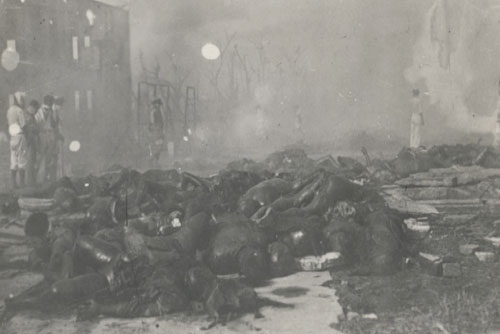


 We don't use depleted uranium in Afghanistan; we don't have a requirement to use that


